
Your ADHD Brain On Paper

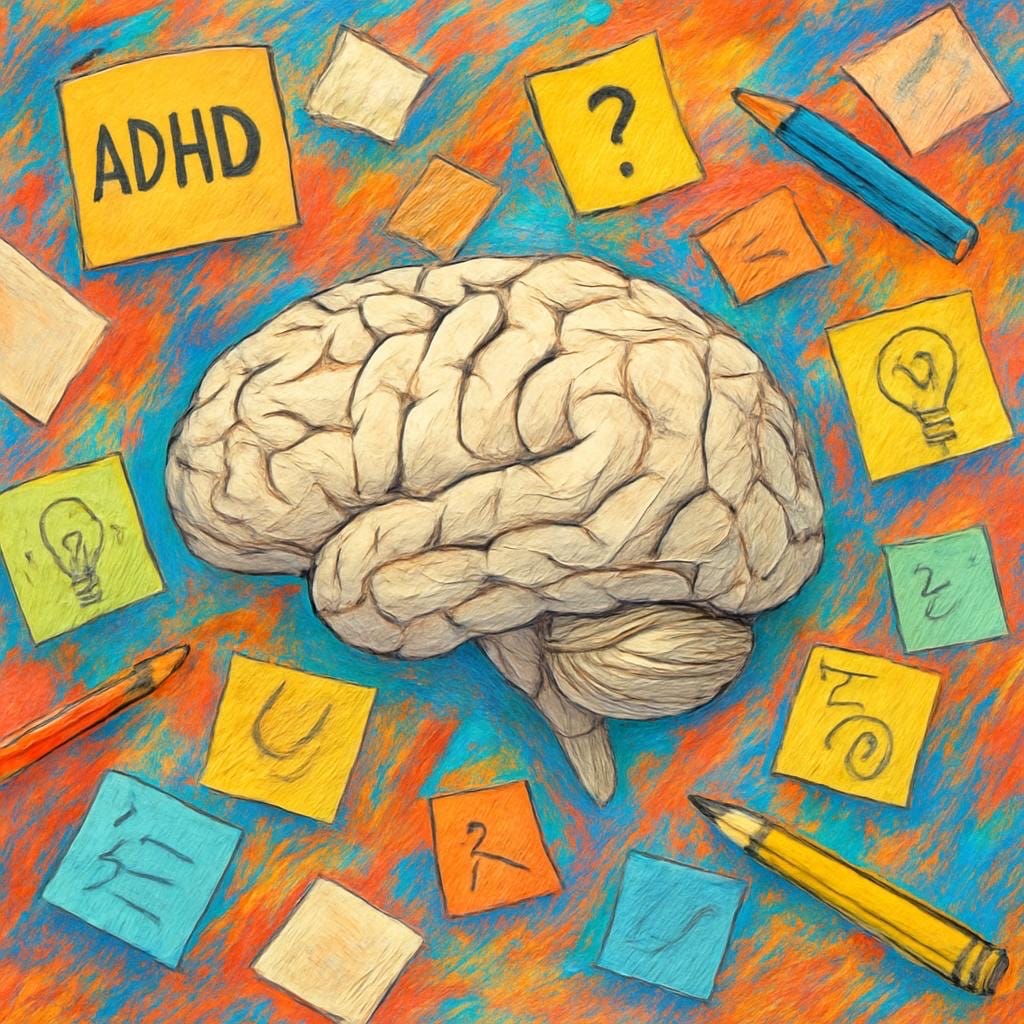
Look, I get it. The idea of sitting down to journal every day sounds about as appealing as filing taxes or folding fitted sheets when you have ADHD. So you’re supposed to just… sit there and write? With your brain that’s currently thinking about seventeen different things, including that weird thing you said in seventh grade and whether octopuses have favorite tentacles?
But here’s the thing: journaling for ADHD brains isn’t about becoming some zen, perfectly organized human who glides through life with color-coded planners and matching socks. It’s about working with your beautifully chaotic brain instead of against it. And honestly? It might be one of the most underrated tools in your ADHD management toolkit.
Let’s talk about what’s actually happening up there in that magnificent mess you call a brain. ADHD brains are like having forty-two browser tabs open at once, except half of them are playing different songs, three are buffering, and you can’t remember which tab that important thing was in. The technical term for this is “executive dysfunction,” but let’s just call it what it is: your brain’s filing system is run by a very enthusiastic but extremely disorganized intern.
This is where journaling becomes your secret weapon. Think of it as creating an external hard drive for your brain. All those thoughts that are bouncing around like popcorn kernels, you’re giving them somewhere to land. That nagging feeling that you’re forgetting something important? Write it down, and your brain can finally stop using valuable processing power to keep it on loop.
One of the most immediate benefits of journaling with ADHD is what I like to call “the mental dumping ground effect.” Your brain is carrying around an exhausting amount of mental clutter: half-formed ideas, random worries, things you need to remember, things you’ve already done but your brain won’t stop reminding you about anyway, and approximately eight thousand shower thoughts.
When you dump all of this onto paper, something magical happens. Your brain finally gets the memo that it doesn’t need to keep juggling these thoughts anymore. They’re written down. They’re safe. Your working memory can actually work on, you know, the present moment. Studies have shown that people with ADHD often have challenges with working memory, that mental sticky note system that helps you hold information in your mind. Journaling essentially gives you infinite external sticky notes.
It’s like when you have too many apps running on your phone and it starts getting hot and slow. Journaling is the equivalent of closing those apps. Suddenly, you have mental bandwidth you forgot existed.
Here’s something wild about ADHD: you can live the same day seventy times and never notice the pattern. You feel terrible every afternoon but can’t figure out why. You get into the same argument with your partner repeatedly but it always feels like it comes out of nowhere. You have productive days and disaster days but see no rhyme or reason to either.
See, journaling turns you into a detective of your own life. When you write things down consistently, patterns start emerging from the chaos like one of those Magic Eye pictures. Oh, you always crash after eating lunch at your desk. Interesting. You’re consistently overwhelmed on days when you have back-to-back meetings with no breaks. Noted. Your mood tanks when you skip your morning walk. Well, would you look at that.
This isn’t about judging yourself or forcing yourself into some neurotypical mold. It’s about gathering actual data on what works for your specific, unique, wonderfully weird brain.
Maybe you’re more creative at midnight.
Maybe you need three small tasks to feel accomplished rather than one big one.
Maybe talking to yourself in your journal (yes, this is normal and valid) helps you process emotions in a way nothing else does.
Time blindness is one of those ADHD features that sounds made up until you experience it. It’s Tuesday, then you blink, and suddenly it’s Saturday and you’ve missed three appointments and can’t account for where the week went. Or the reverse: you have twenty minutes before you need to leave, which somehow feels exactly the same as having three hours.
A journal becomes your time travel device. Not in a sci-fi way (unfortunately), but in a “holy crap, I can actually see where my time went” way. When you write even brief daily entries, you create breadcrumbs through your life. You can look back and see what you actually did, what actually happened, how long things actually took.
This is incredibly valuable for future planning. That project you thought took two hours? Your journal reveals it actually took six. Those errands you think you can knock out in twenty minutes? Past journal entries show they consistently take an hour and a half. This isn’t about making you feel bad; it’s about giving you realistic information to work with. Plus, there’s something deeply satisfying about looking back at your journal and realizing you actually accomplished things.
The ADHD brain has a terrible habit of dismissing everything you’ve done while catastrophizing everything you haven’t. Your journal is proof that you’re not, in fact, the lazy disaster your brain sometimes insists you are.
Let’s talk about feelings, because if you have ADHD, you probably have a lot of them, often all at once, frequently at maximum volume. Emotional dysregulation is a hallmark of ADHD that doesn’t get enough airtime. It’s not that you’re overly emotional or immature; your brain processes emotions differently and more intensely.
Writing about emotions is like turning down the volume just enough that you can hear the lyrics. When you’re overwhelmed, anxious, angry, or sad, those feelings can be so big and loud that they fill your entire mental space. Getting them onto paper creates just enough distance that you can start to understand what you’re actually feeling and why.
There’s actual science backing this up. Expressive writing has been shown to reduce anxiety, improve mood, and even boost immune function. For ADHD brains specifically, it helps bridge the gap between feeling something intensely and being able to articulate or manage it. Sometimes you don’t even realize what’s bothering you until you start writing and suddenly there it is, clear as day.
And here’s the beautiful part: unlike talking to a person, your journal never gets tired of hearing about the same worries. It never judges you for having the same emotion again. It never says “didn’t we already talk about this?” It’s endlessly patient with your brain’s tendency to loop.
Staying accountable to goals when you have ADHD is like trying to herd cats while riding a unicycle. On a tightrope. During an earthquake. Your intentions are excellent. Your follow-through is… variable.
A journal becomes your accountability partner, but one that you can’t disappoint or make feel bad. You can write down goals, track progress, notice what obstacles keep showing up, and adjust course without anyone making you feel guilty about changing directions for the fortieth time.
The key here is that journaling removes the need to remember everything you’re trying to do. You don’t have to keep your goals, intentions, and habits floating around in your already-overloaded brain. They’re in your journal. You can check in with them, update them, celebrate progress, or acknowledge when something isn’t working without the shame spiral.
And let’s be real: the ADHD brain loves fresh starts. New week, new you. Monday morning, clean slate. Journaling lets you have as many fresh starts as you need while still maintaining some thread of continuity. You can see that yes, this is the fourteenth time you’ve committed to drinking more water, but you can also see that the last three attempts actually worked for a few days, and maybe there’s a pattern to when and why they fell apart.
One of the sneakiest ways ADHD sabotages you is through intrusive thoughts at exactly the wrong moment. You’re in the middle of an important task, and your brain suddenly serves up a random thought like “I should learn to make pottery” or “did I respond to that email from three weeks ago?” or “what if I organized my entire bookshelf by color?”
These thoughts are insistent. They feel urgent. They demand immediate attention. And if you try to just ignore them, they’ll keep popping up like the world’s most annoying game of whack-a-mole.
This is where the “thought parking lot” technique comes in. Keep your journal nearby while you work. When a random thought appears, write it down immediately. Don’t evaluate it, don’t act on it, just capture it. This tells your brain “okay, we got it, it’s saved, we won’t forget” and the thought can finally leave you alone.
At the end of the day (or week), you can review your parking lot. Half of those urgent thoughts will seem completely random in hindsight. But some of them might actually be worth exploring. The point is, you’ve separated the thought from the action, which gives you back control over your attention.
ADHD and memory have a complicated relationship. You can remember the entire plot of a TV show you watched once fifteen years ago but not what you had for breakfast. You can recall obscure facts about topics that interest you but forget your best friend’s birthday. It’s not that your memory is bad; it’s selective and unreliable in frustrating ways.
Journaling becomes the memory you can actually trust. Conversations you had, decisions you made, ideas you wanted to explore, feelings you experienced, they’re all there, written down, safe from the chaos of your unreliable brain storage system.
This is especially valuable for relationships. How many times have you had an argument about whether something was said or agreed upon, and you genuinely can’t remember? Your journal can provide clarity. It’s also helpful for tracking medical symptoms, side effects from medications, or patterns in your physical health that you might not otherwise notice.
Now, I know what you’re thinking. This all sounds great, but you’ve tried journaling before and it lasted exactly three days before the notebook ended up under a pile of unfolded laundry, never to be seen again.
The secret is this: throw out every rule about what journaling “should” look like. You don’t need to write every day. You don’t need complete sentences. You don’t need neat handwriting or proper grammar or any of that stuff your English teacher cared about.
Bullet points? Perfect. Stream of consciousness rambling? Excellent. Drawing little doodles in the margins? Chef’s kiss. Writing the same sentence five times because your brain got stuck? Completely valid. Dating your entries is helpful, but if you forget, the journal police aren’t coming for you.
Some people with ADHD prefer voice-to-text apps because typing or writing feels like too much friction. Some like to journal in the morning to set intentions, others at night to process the day. Some write for thirty minutes, others for three. The best journaling practice is the one you’ll actually do, not the one that looks prettiest on Instagram.
The goal isn’t perfection. It’s not even consistency, really. It’s creating a tool that serves your brain, reduces your cognitive load, and helps you navigate life with a little more clarity and a little less chaos.
Here’s the truth: living with ADHD is exhausting in ways that people who don’t have it can’t fully understand. Your brain is working overtime all the time, managing distractions, fighting against executive dysfunction, trying to regulate emotions, and attempting to stay on top of the eight million things that life throws at you.
Journaling won’t cure your ADHD. It won’t make you suddenly organized or punctual or able to remember where you put your keys. But it can make your daily life just a little bit easier. It can give your overworked brain somewhere to rest. It can help you understand yourself better, manage your time more realistically, and feel less like you’re constantly forgetting something important.
Your messy, scattered, chaotic, brilliant brain deserves support. It deserves a tool that works with it instead of against it. Maybe that tool is a journal. There’s only one way to find out, and it starts with opening a notebook and writing down whatever thought is bouncing around your head right this second.
Trust me, your brain will thank you. Probably not immediately, it’ll be too busy thinking about seventeen other things, but eventually, you’ll notice the difference.